◇
Greater Wildfire Safety
Helps reduce the risk of your home igniting from embers.
Learn how the proposed California Zone Zero rules may affect fences and gates within 5 feet of Sacramento-area homes. Explore non-combustible fencing options, wildfire mitigation guidance, and connections to CSLB-licensed fencing contractors experienced in Zone Zero applications.
Helps reduce the risk of your home igniting from embers.
Insurers are increasingly focused on wildfire mitigation measures.
Get informed now so you can plan, budget, and avoid future demand bottlenecks.
Connect with CSLB-licensed fencing contractors experienced in non-combustible Zone Zero applications.
Wildfires are a growing threat in California, and homes are often ignited by wind-blown embers. Creating a non-combustible area around your home—known as Zone Zero—can help reduce risk, may support home insurance eligibility, and builds a more resilient community.
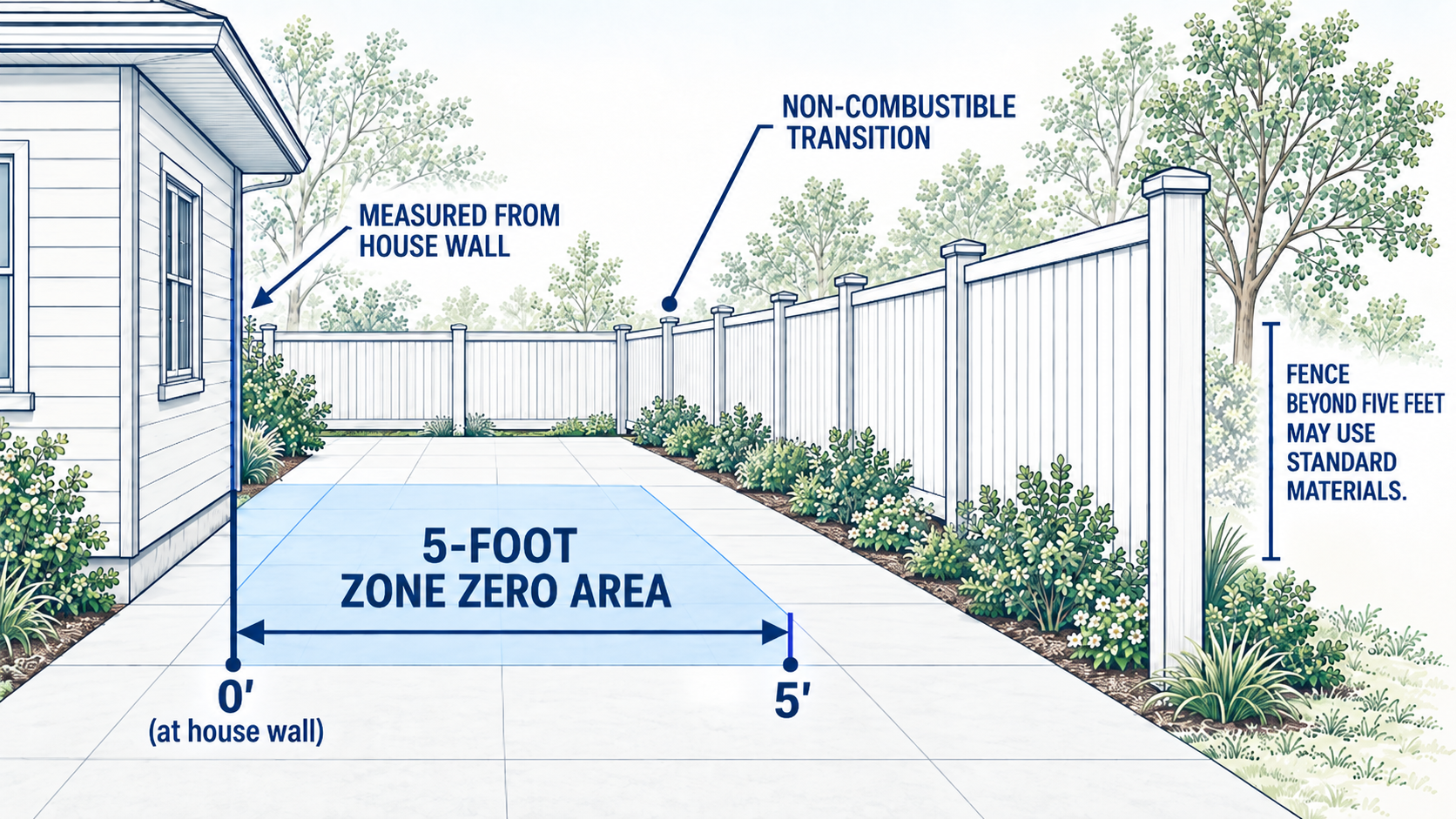
See official wildfire resources →Zone Zero describes the first 5 feet around a structure. Proposed statewide rules focus on reducing combustible material near buildings, including certain fences and gates. Check your exact property and local rules before treating any fence replacement as required.
See if your property may be affected →California’s Safer from Wildfires framework includes an ember-resistant 5-foot zone—including fencing—as a recognized mitigation measure. Your insurer may ask for documentation or a property inspection.
Learn more about insurance and mitigation →Fill out a quick form with your property details.
We’ll connect you with a CSLB-licensed fencing contractor in your area.
The contractor can discuss your needs and next steps. There is no obligation to hire.
Local guidance is available for Sacramento, Folsom, El Dorado Hills, Roseville, Rocklin, Auburn, Granite Bay, Fair Oaks, Orangevale, Carmichael, and Elk Grove.
View All Service Areas →Zone Zero Sacramento helps homeowners understand the first 5 feet around the home, evaluate fence and gate materials near structures, and find independent CSLB-licensed fence contractors experienced with non-combustible Zone Zero applications.
Learn how the 5-foot Zone Zero area may affect wood, vinyl, metal, masonry, gates, and fence transitions near the home.
Explore fence & gate guidance →Review whether your property may fall within an area affected by California Zone Zero defensible-space requirements.
Check my property →Explore metal and other non-combustible fence solutions commonly considered for the area closest to a home.
Learn about Zone Zero →Request a connection to an independent CSLB-licensed fencing contractor experienced in Zone Zero non-combustible fencing.
Request a contractor connection →Serving informational and referral requests from Sacramento, Folsom, El Dorado Hills, Roseville, Rocklin, Auburn, Granite Bay, Fair Oaks, Orangevale, Carmichael, Elk Grove, and nearby Greater Sacramento communities.
A fence that reaches a building can provide a path for flames. Review the first 5 feet from the exterior wall before deciding what to change; a short non-combustible transition may be worth discussing with a licensed contractor.
Mark where fences, gates, landscaping, and stored materials enter the first 5 feet. The property line is not the starting point for this measurement.
Steel, aluminum, masonry, and concrete-based systems are examples to discuss for a non-combustible transition. Confirm the actual product and installation details with the local authority and contractor.
Verify the parcel’s hazard designation, existing defensible-space obligations, local rules, permits, HOA requirements, and any insurer documentation. A whole-fence replacement is not automatically necessary.
Statewide rulemaking can change, and local rules may differ. Use these government sources alongside your property-specific check.
Quick answers about the 5-foot Zone Zero area, fencing, non-combustible materials, insurance mitigation, and licensed contractor referrals.
Zone Zero is the first 5 feet around a structure. California law directs the Board of Forestry and Fire Protection to establish an ember-resistant defensible-space zone in this area, with requirements focused on reducing combustible material close to buildings.
Fencing is part of the Zone Zero discussion because combustible fence materials can create an ignition pathway toward a structure. The exact requirements depend on the final regulation, the property, and the local authority having jurisdiction.
Common non-combustible fence materials include steel, aluminum, masonry, and concrete-based systems. A contractor should verify the specific product, installation method, and applicable local requirements for your property.
The 2026 emergency filing was withdrawn. The Board of Forestry says its Zone 0 rule package remains in final review with the Office of Administrative Law. Check the Board’s current status and any separate local rules before making compliance decisions.
California’s Safer from Wildfires framework recognizes a 5-foot ember-resistant zone, including fencing, as a mitigation action that can qualify for insurance discounts. Eligibility, documentation, inspection requirements, and discount amounts vary by insurer and property.
Yes. When requested, Zone Zero Sacramento may connect homeowners with independent CSLB-licensed fencing contractors experienced in non-combustible Zone Zero applications. There is no obligation to hire, and Zone Zero Sacramento does not perform the construction work.
Share a few details about the property, the fence or gate closest to the home, and what you are trying to accomplish. We may connect you with an independent CSLB-licensed fencing contractor experienced in non-combustible Zone Zero applications.
There is no obligation to hire. Zone Zero Sacramento is an independent informational and contractor-referral website and does not perform construction.
We may receive compensation when we connect you with a participating contractor.
Get the information you need and connect with a trusted, CSLB-licensed fencing contractor.
Choose a community on the map or from the list to open its local Zone Zero fencing guide. Each page focuses on that area's fire authority, hazard mapping, local requirements, and property-specific resources.
Click a city or community name on the map to open its local guide.